
How to Choose a Portable Tyre Inflator: A UK Driver’s Guide
That dreaded dashboard light flickers on: "Tyre Pressure Low." For many UK drivers, this means a frustrating detour to a petrol station, only to find the air machine is out of order, requires exact change or is caked in grime. A portable tyre inflator is a simple solution, a small device that lives in your boot and saves you from these roadside hassles.
However, the market is flooded with options, and it's easy to buy a gadget that fails when you need it most. As the Joybuy Product Recommendation Officer, my role is to help you see past the marketing clutter. Before you buy, be aware of these common pitfalls that lead to wasted money and disappointment.
- The "Fast Inflation" Myth: Many models boast of rapid inflation, but their claims are often based on topping up a small bicycle tyre. When faced with a partially deflated SUV tyre, these units can struggle, overheat and take far longer than advertised, if they finish the job at all.
- The Unreliable Power Trap: A cheap cordless tyre inflator with a small battery might only have enough power to inflate one tyre before it dies, leaving you stranded. Conversely, a 12V air compressor with a flimsy power plug or a short cable can be equally useless.
- The "All-in-One" Illusion: A device that claims to be a jump starter with air compressor, power bank and torch can seem like a great deal. However, often these multi-tools compromise on core functions. You might find the air compressor is an underpowered afterthought, unable to handle a simple car tyre.
Decoding the Specifications: What Really Matters
To avoid these traps, focus on a few core parameters that determine a unit's real-world performance and reliability.
1. Power Source: Cordless, 12V or Dual-Power?
The way an inflator is powered dictates its convenience and reliability.
- Cordless (Rechargeable): These offer maximum portability. A rechargeable air pump is perfect for quick top-ups anywhere, without needing to be tethered to your car. The key is battery capacity, measured in milliampere-hours (mAh). A larger capacity (4000mAh or more) ensures you can inflate multiple tyres or handle a full inflation from flat without the battery dying.
- 12V DC (Car Socket): This type plugs directly into your car's cigarette lighter socket. It provides a consistent and reliable power source as long as your car is running. The main limitation is the length of the power cord, which needs to be long enough to comfortably reach all four tyres.
- Dual-Power: Some models offer the best of both worlds: a built-in rechargeable battery for cordless convenience and a 12V cable for backup power. This is an excellent option for those who want flexibility and peace of mind.
2. Performance Metrics: PSI and Airflow (L/Min)
These two numbers define how powerful and fast your inflator is.
- Maximum Pressure (PSI): This stands for "Pounds per Square Inch." Most car tyres require between 30-40 PSI. While many inflators advertise a high maximum like 150 PSI, this figure mainly indicates the motor's robustness rather than being a pressure you'll ever need for a car. A higher max PSI suggests the motor won't be straining at its limit to inflate your tyres.
- Airflow (L/Min): This is the most important, yet often overlooked, specification for inflation speed. Measured in Litres Per Minute, it tells you how much air the compressor can move. A higher L/Min rating means the inflator will fill your tyre much faster. For a standard family car, 20-25 L/Min is adequate. For larger SUVs or vans, look for 35 L/Min or more to avoid long waits.
3. Essential Features: Digital Display and Auto Shut-Off
Modern features have made tyre inflation safer and simpler.
- Digital Tyre Inflator with Pressure Gauge: An easy-to-read digital screen is a must. It allows you to see the current pressure of your tyre and set your target pressure with precision. This removes the guesswork associated with older analogue gauges.
- Automatic Shut-Off: This is a crucial safety feature. You simply set your vehicle's recommended PSI on the device, press start and the inflator will automatically stop once it reaches the target pressure. This prevents dangerous and damaging over-inflation and allows you to get on with other things while it works.
Our Top Product Recommendations
Instead of a one-size-fits-all approach, we've matched a few standout options to different types of UK drivers.

AstroAI Tire Inflator L7S Portable Air Compressor
Why This Fits Their Persona: This inflator is incredibly compact and lightweight, making it perfect for storing in a glovebox or backpack. It's ideal for the driver who needs a no-fuss tool for routine pressure checks and occasional top-ups on a standard car, motorcycle or bicycle.
It avoids the "unreliable power" trap with a solid 4000mAh battery, providing enough charge to top up multiple tyres without needing a power cord, unlike cheaper, under-specced models.
Features a clear dual-value display for accurate readings and an auto-off function for safety. It also doubles as a power bank for your phone in a pinch.
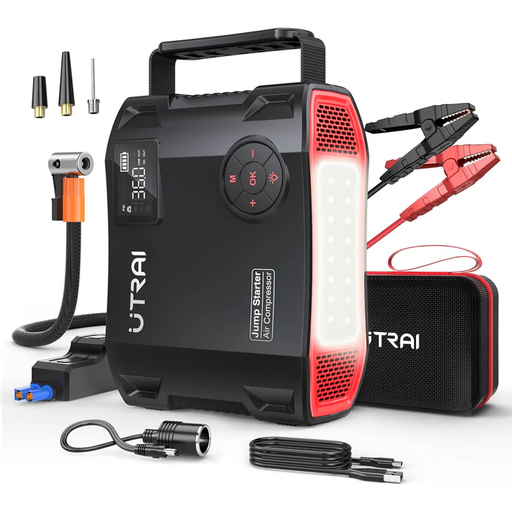
UTRAI JS5 6000A Car Battery Jump Starter with Air Compressor
Why This Fits Their Persona: For the driver who wants to be ready for anything. This unit combines a seriously powerful jump starter, capable of starting large diesel engines, with a fast and effective air compressor. It's the ultimate single-device solution for the two most common roadside breakdowns.
It shatters the "all-in-one illusion" by providing high-end specifications for both functions: a 6000A peak current for jump-starting and a high 45L/min airflow for rapid inflation.
Its huge 27,000mAh battery capacity and 160W DC output can power other 12V devices like a car fridge or vacuum. The bright 1600 lumen LED is also a significant upgrade over typical inflator lights.

WOLFBOX 150PSI Heavy Duty Tire Inflator Portable Air Compressor
Why This Fits Their Persona: This is a no-nonsense, powerful inflator for drivers of larger vehicles. Its dual-cylinder motor is specifically designed to move more air, making it ideal for the higher-volume tyres found on SUVs, pickup trucks and vans, where smaller inflators would struggle and overheat.
It directly counters the "fast inflation" myth by delivering a genuinely high airflow of 45L/min, providing the speed and power needed for large tyres without exaggeration.
The heavy-duty, dual-cylinder design ensures durability and efficient heat dissipation during longer inflation jobs. It also features a large 3.5-inch LED display for clear visibility.
Looking for More Options?
We have compiled a complete, real-time list of products that fully satisfy these strict selection criteria and UK safety regulations.
Frequently Asked Questions
1. How long does a portable tyre inflator last?
The lifespan of a portable air compressor depends on its build quality and how it's used. A well-made unit with a metal cylinder and a good cooling system can last for many years with occasional use. For cordless models, battery health is key; to prolong its life, avoid storing it fully discharged and try to recharge it every 3-4 months if unused. Also, respect the 'duty cycle' mentioned in the manual—this is the maximum continuous running time before the motor needs to cool down.
2. Is a cordless or 12V tyre inflator better?
Neither is inherently "better"; it depends on your needs. A cordless tyre inflator is unmatched for convenience and can be used anywhere. A 12V air compressor offers unlimited runtime as long as your car's engine is on, making it more reliable for inflating multiple flat tyres or large items. A dual-power model provides the most flexibility, giving you both options.
3. Can I leave a portable air compressor in my car in winter?
Yes, most are designed to be stored in a vehicle. Many models, especially those combined with a jump starter, are rated to operate in temperatures as low as -20°C. However, extreme cold can temporarily reduce the efficiency of lithium-ion batteries. If you have a cordless model, its performance will be better if it's not stored in freezing temperatures for extended periods. Always check the manufacturer's specified operating temperature range.