
A Guide to Non-Toxic Cookware: Our Top Recommendations for 2026
As home cooks in the UK become more mindful of the ingredients in their food, it's only natural that attention turns to the tools we cook with. The conversation around non-toxic cookware can be confusing, filled with acronyms like PFOA and PFAS, and debates about which materials are genuinely safer. If you're looking to replace old pans and want to make a more informed choice for your kitchen, you're in the right place.
This guide is designed to cut through the marketing clutter. As a Joybuy Product Recommendation Officer, my role is to provide clear, practical advice to help you understand your options and select cookware that aligns with your household's needs. We will explore what makes cookware "non-toxic" and highlight a few standout products that prioritise performance and material safety.
What to Look for When Choosing Healthy Cookware
Navigating the options for healthy non-stick pans can feel overwhelming. Focussing on a few key factors can simplify your decision-making process.
1. Understand the Core Materials
The term "non-toxic" primarily refers to the absence of certain chemicals in the cooking surface, particularly in non-stick coatings.
- Ceramic Coatings: A ceramic non-stick pan features a coating derived from sand (silica), applied as a gel and cured. It provides a smooth, non-stick surface without the use of Polytetrafluoroethylene (PTFE) or Perfluorooctanoic acid (PFOA). This makes it a popular choice for those seeking cookware without Teflon.
- Granite-style Coatings: Often referred to as granite cookware, this type typically involves a multi-layer, mineral-reinforced coating over a durable aluminium base. It's essential to check that the product is explicitly a PFOA free frying pan, as the quality and composition can vary between brands.
- Innovative Stainless Steel: Some modern cookware uses physical design rather than chemical coatings to achieve a non-stick effect. Woks and pans with an engraved honeycomb texture create an air cushion under food, significantly reducing sticking while offering the durability and high-heat tolerance of stainless steel.
2. Check for Versatility and Compatibility
Your new cookware should fit seamlessly into your kitchen routine.
- Stovetop Type: If you have a modern kitchen, ensuring you have an induction cookware set is crucial. Look for a flat, magnetic base, often made of stainless steel, which is necessary for induction hobs to function. Most modern pans are designed for compatibility with gas, electric and induction.
- Oven Use: An oven safe skillet adds a layer of versatility to your cooking, allowing you to sear a steak on the hob and finish it in the oven without changing pans. Always check the manufacturer's specified maximum temperature, paying attention to both the pan and the handle material.
Our Top Recommendations for Non-Toxic Cookware in 2026
Based on their materials, features and user-centric design, here are a few recommendations for your consideration.
PURECOOK Non-stick Wok - No Teflon Wok, 32 cm
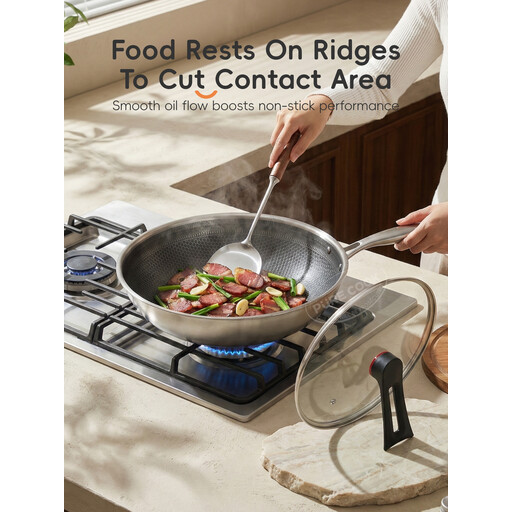
- Why It Stands Out: This non-stick wok achieves its performance without any chemical coatings. It uses a precisely etched honeycomb pattern on food-grade 304 stainless steel. This physical barrier minimises surface contact, allowing food to slide easily while offering the searing power and durability of steel. It's an excellent example of cookware without Teflon.
- Pros:
- Durable Construction: Made from a three-layer composite steel for fast, even heating.
- Metal Utensil Safe: The stainless steel surface is scratch-resistant, unlike many coated pans.
- Universal Compatibility: Works perfectly on gas, electric and induction hobs.
- Large Capacity: The 32 cm diameter is ideal for stir-frying, braising and family-sized meals.
- Who is it for? For the home cook who loves high-heat cooking like stir-frying and wants a long-lasting, chemical-free pan that isn't delicate.
SENSARTE Nonstick Frying Pan Skillets, Swiss Granite Coating
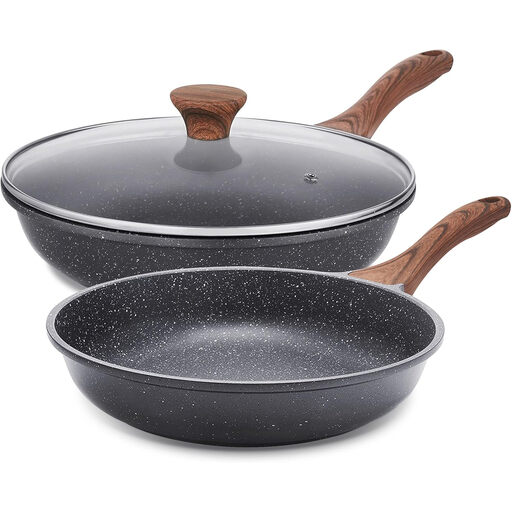
- Why It Stands Out: This set offers a practical combination of an 8-inch and 11-inch pan, making it a versatile foundation for any kitchen. The Swiss ILAG granite cookware coating is designed for easy food release and is explicitly made without intentionally added PFOA, PFOS or other known chemicals of concern.
- Pros:
- Healthy Non-Stick: The granite-style coating allows for cooking with minimal oil and is easy to clean.
- Induction Ready: A high-magnetic conductive base makes this a reliable induction cookware set.
- Oven Safe: Both pans are oven safe up to 204°C (400°F), perfect for a range of recipes.
- Convenient Design: Features stay-cool bakelite handles and a tempered glass lid for the larger pan.
- Who is it for? Anyone seeking a reliable, everyday set of healthy non-stick pans that are easy to use, simple to clean and compatible with all stovetops.
SENSARTE Nonstick Frying Pan Skillets, White Ceramic Coating
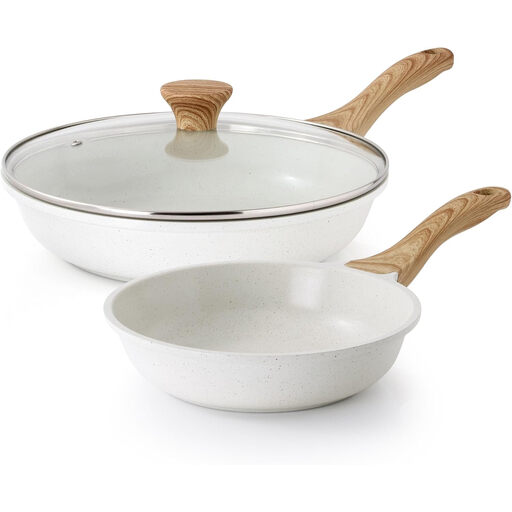
- Why It Stands Out: For those who specifically want a ceramic non-stick pan, this SENSARTE set is an excellent choice. The natural ceramic coating is free from intentionally added PFAS, PTFE and PFOA. It also boasts a higher oven-safe temperature than many competitors, adding to its versatility.
- Pros:
- Advanced Safety Profile: The ceramic coating is designed not to release fumes, even if accidentally overheated.
- High-Heat Versatility: This oven safe skillet can withstand temperatures up to 287°C (550°F).
- Even Heating: The die-cast aluminium body ensures there are no hot spots, for consistent cooking results.
- Universal Compatibility: Works on all stovetops, including induction.
- Who is it for? The health-conscious cook who prioritises a PTFE-free ceramic surface and needs a pan that can transition from a high-heat sear on the hob to finishing in a hot oven.
Looking for More Options?
While these selections cover some of the most popular and effective types of non-toxic cookware, every kitchen has unique needs. If you're searching for a different size, material or style, you can explore a wider variety of options.
Discover more choices in our broader collection of Lid Frying Pan selections to find the perfect match for your culinary adventures.
Frequently Asked Questions About Non-Toxic Cookware
Q1: Is ceramic cookware truly non-toxic? A: Cookware with a ceramic coating is widely considered a safe and non-toxic option. The coating is made from a silica-based gel (sand) and does not contain PTFE or PFOA. To maintain its integrity and non-stick properties, it's important to avoid using metal utensils and harsh scouring pads and to prevent sudden temperature changes (like putting a hot pan in cold water).
Q2: What is the difference between a PFOA-free and a PTFE-free pan? A: PFOA was a chemical used in the manufacturing process of PTFE, but it has been largely phased out of production due to health and environmental concerns. A PFOA free frying pan means this specific chemical was not used. PTFE is the actual non-stick coating material itself (famously known by the brand name Teflon). While stable at normal cooking temperatures, it can degrade at very high heat. Pans marketed as PTFE-free, such as ceramic or certain stainless steel models, use entirely different materials for their non-stick surface.
Q3: Can I use metal utensils on all non-toxic cookware? A: This depends entirely on the surface material. For most coated pans, including ceramic and granite-style ones, it is strongly recommended to use wood, silicone or nylon utensils to prevent scratching and prolong the life of the non-stick surface. However, some uncoated pans, like the PURECOOK wok with its durable stainless steel honeycomb texture, are robust enough to handle metal utensils without damage. Always refer to the manufacturer's care instructions.