
Car Jump Starter Buying Guide: Top Recommendations for Flat Batteries
That dreaded silence when you turn the key is a moment every driver fears. A flat car battery can disrupt your day, whether you're on the way to work, picking up the children or setting off on a holiday. In the past, the only solution was a set of cumbersome jump leads and a willing second driver. Today, a modern car jump starter offers a compact, powerful and independent solution.
These portable devices, also known as a car battery booster or jump pack, can get your vehicle running again in minutes without needing another car. But with so many options available, choosing the right one can be confusing. This guide will walk you through the key features to consider and present our top recommendations to help you find a reliable device for your needs.
How to Choose the Right Portable Jump Starter
Making an informed choice comes down to understanding a few key specifications. Here’s what to look for to ensure you get a device that’s right for your vehicle and lifestyle.
1. Power and Vehicle Compatibility
The most important factor is the starter's power, measured in peak amps (A). This determines its ability to deliver the burst of energy needed to turn over an engine. A small petrol hatchback has very different requirements from a large diesel van.
- Engine Size: Check the product specifications for the recommended engine displacement (measured in litres). A jump starter for diesel engines typically requires more power than one for a petrol equivalent.
- Peak Current: For most standard 12V cars in the UK, a jump starter with 400A to 1000A is usually sufficient. For larger SUVs, vans or if you need a heavy duty jump starter, look for models offering 1500A or more.
- Voltage: The vast majority of personal vehicles in the UK use a 12V jump starter. Commercial trucks may require 24V, so always confirm your vehicle's system.
2. Battery Technology and Safety
The internal battery determines the device's performance, lifespan and safety. Most units use lithium-ion batteries, but newer technologies are emerging.
- Lithium-ion: These are lightweight and powerful, making them a popular choice. However, their performance can be affected by extreme temperatures and they require periodic recharging every 3-6 months to maintain their health.
- Sodium-ion: A newer alternative known for its stability and durability. These batteries often have a much wider operating temperature range (from deep freezes to high summer heat), a significantly lower self-discharge rate (meaning they can hold a charge for years) and an inherently safer chemistry that reduces the risk of fire.
Always look for models with built-in safety features, such as reverse polarity, short-circuit and over-charge protection. These safeguards prevent damage to the jump starter and your car's electronics if the clamps are connected incorrectly.
3. Additional Functions
Many modern jump starters are multi-functional tools. A jump starter power bank is standard, allowing you to charge phones, tablets and laptops via USB ports. Some models go even further, offering practical features for emergencies and outdoor activities.
A jump starter with air compressor is particularly useful for topping up tyre pressure on the go. Other common features include powerful LED torches with SOS and strobe modes and DC outputs to power 12V accessories like portable coolers or car vacuum cleaners.
Our Top Product Recommendations
Here are our recommendations, selected to meet a range of needs, from everyday commuting to heavy-duty use and all-in-one emergency preparedness.
GOKKCL GK03 Sodium Ion Car Jump Starter
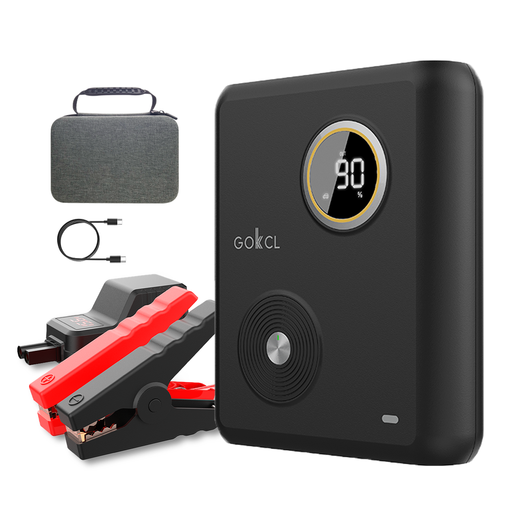
Why It Stands Out: The GOKKCL GK03 is built around advanced sodium-ion battery technology, setting it apart in terms of durability and reliability. Its standout feature is an exceptionally long standby time of up to 5 years, thanks to a very low self-discharge rate. This makes it a true "set and forget" device you can trust to be ready when you need it. It operates effectively in extreme temperatures, from -40°C to 80°C, and its chemistry is inherently non-flammable, offering an additional layer of safety.
Pros:
- Extremely long 5-year standby time requires minimal maintenance.
- Wide operating temperature range, suitable for all UK weather.
- Inherently fireproof sodium-ion chemistry for enhanced safety.
- Can be recharged even after being fully discharged to 0V.
Who is it for? Drivers who prioritise safety, reliability and low maintenance. It's an excellent choice for anyone who wants a car battery booster they can store in their vehicle year-round without worrying about frequent recharging or temperature damage.
GOOLOO GT4000S Jump Starter
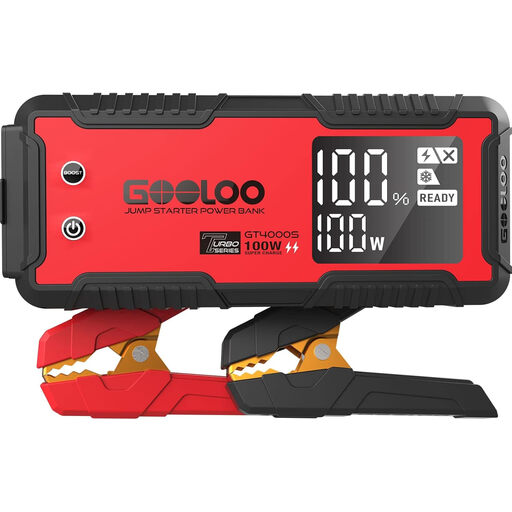
Why It Stands Out: The GOOLOO GT4000S is all about power and speed. With a formidable 4000A peak current, it has the muscle to start large engines up to 10.0L diesel. Its defining feature is the 100W two-way fast charging. This allows the unit itself to be fully recharged in just over an hour and enables it to function as a high-speed power bank for laptops and other devices, delivering charging speeds comparable to their original adaptors. The 3.2-inch screen provides clear, at-a-glance status information.
Pros:
- Very high 4000A peak current for large petrol and diesel engines.
- Ultra-fast 100W two-way charging for the unit and other devices.
- Functions as a high-speed laptop charger.
- Clear and informative LED display.
Who is it for? Owners of large vehicles like SUVs, vans, motorhomes and trucks. It's also ideal for tech-savvy users who need a powerful jump starter power bank that can rapidly charge all their electronics, including a MacBook or other laptops.
View Details for GOOLOO GT4000S
UTRAI 7000A Jump Starter with Air Pump Compressor
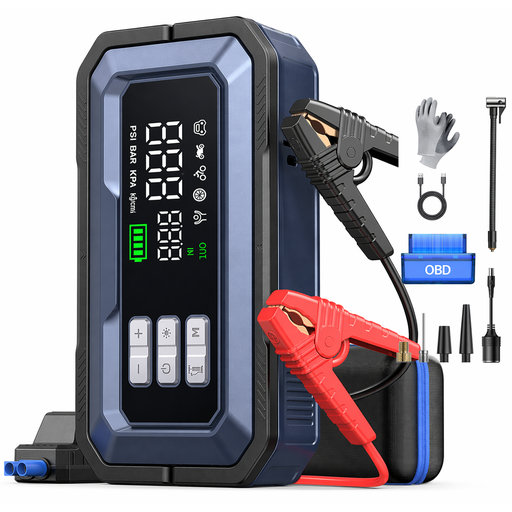
Why It Stands Out: The UTRAI JS-30 is a comprehensive roadside emergency toolkit in a single unit. It boasts an immense 7000A peak current, making it capable of starting even the largest 14L diesel engines. Beyond its power, it integrates a 150 PSI air compressor for tyres, a powerful 2000-lumen work light and even an OBD2 fault code reader to help diagnose engine issues. The 160W DC output can power 12V accessories, making it a versatile companion for camping and outdoor trips.
Pros:
- Massive 7000A peak current for heavy-duty applications.
- Integrated multi-function air compressor with auto-stop.
- Includes an OBD2 diagnostic tool to read engine fault codes.
- Powerful work light and 160W DC output for accessories.
Who is it for? The DIY car enthusiast, outdoor adventurer or anyone who wants an all-in-one emergency device. Its combination of a heavy duty jump starter, air compressor and diagnostic tool makes it one of the most versatile options available.
Looking for More Options?
If these models don't perfectly match what you're looking for or if you'd like to compare them against a wider selection, there are many other excellent devices to consider.
Explore Our Full Range of Portable Car Jump Starters
Frequently Asked Questions
1. Can a car jump starter damage your car? A modern, high-quality portable jump starter is designed with multiple safety features to prevent damage. Protections against reverse polarity (connecting clamps to the wrong terminals), short circuits and over-voltage are standard. As long as you follow the manufacturer's instructions, the risk of damaging your vehicle's electronics is extremely low.
2. How many amps do I need to jump start my car? This depends on your engine size and type. For most small-to-medium petrol cars, 400A-600A is sufficient. For larger petrol engines, SUVs and small diesel cars, 1000A-1500A is a safer bet. For large diesel trucks and vans, you should look for a heavy duty jump starter with 2000A or more. Always check the manufacturer's recommendation for engine compatibility.