
Choosing a Professional Car Diagnostic Tool: A UK Mechanic's Guide
As vehicle systems become increasingly complex, a simple code reader is no longer sufficient for professional vehicle technicians and serious DIY enthusiasts. Modern diagnostics require tools that can communicate with every module, perform active tests and handle advanced programming. Choosing the right car diagnostic tool is a critical investment for any workshop or garage, directly impacting efficiency and profitability.
This guide is designed to cut through the marketing jargon. As the Joybuy Product Recommendation Officer, my role is to provide clear, practical advice to help you select a diagnostic scanner that meets the demanding needs of a modern vehicle workshop in the UK. We will explore the essential features to look for and highlight some of our top recommendations for 2026.
Key Considerations Before You Buy
Navigating the specifications of a professional car scanner can be challenging. Here are a few crucial factors to consider to ensure you get a tool that serves you well now and in the future.
1. Beyond Reading Codes: Bi-Directional Control and ECU Coding
A true mechanic scan tool goes far beyond reading and clearing Diagnostic Trouble Codes (DTCs). The most significant step-up in functionality is bi-directional control, also known as an active test scanner. This allows the tool to send commands to a vehicle's ECU to actuate components. You can test injectors, cycle ABS pumps, operate electronic parking brakes and control windows or fans directly from the tablet. This capability is indispensable for accurately pinpointing faults without having to swap parts.
Furthermore, an ECU coding tool is vital for workshops that handle module replacements. It allows you to re-flash vehicle control modules, program adaptive data for new components and unlock hidden features, providing solutions for issues related to drivability, fuel efficiency and power loss.
2. Future-Proofing with Protocol Support: CAN FD & DoIP
The communication protocols used in vehicles are constantly evolving. Since 2020, many manufacturers, including GM, Jaguar Land Rover and BMW, have started implementing CAN FD (Flexible Data-Rate) and DoIP (Diagnostics over Internet Protocol). These protocols allow for much faster data transfer, which is essential for diagnosing and programming the complex systems in modern cars. A CAN FD DoIP tool ensures you won't be locked out of servicing newer models, making it a critical feature for any forward-thinking garage.
3. Comprehensive Functions and Vehicle Coverage
Look for a tool that offers a wide array of service resets. A scanner with 30+ reset functions will cover the most common workshop tasks, including oil resets, SAS calibration, DPF regeneration, ABS bleeding, injector coding and key programming. Broad vehicle coverage across European, Asian and American brands is equally important to maximise the tool's utility and return on investment.
Recommended Car Diagnostic Tools
Based on features, compatibility and user feedback, here are our recommendations for professional-grade diagnostic tools that deliver advanced capabilities for UK workshops.
LAUNCH X431 CRP919E BT Car Diagnostic Tool
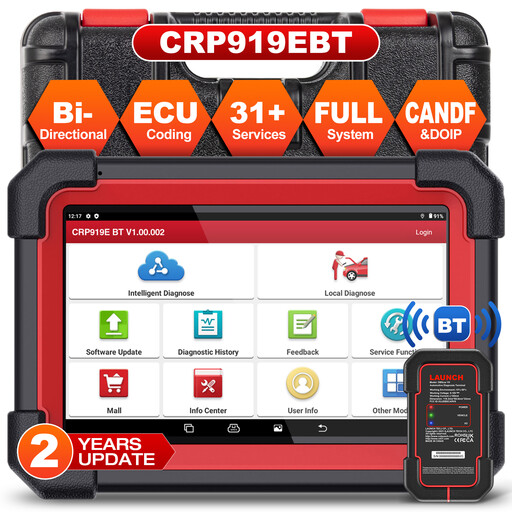
Why It Stands Out: The LAUNCH CRP919E BT is a powerful wireless car scanner that combines OE-level diagnostics with the convenience of Bluetooth connectivity. Its support for both CAN FD and DoIP protocols makes it an excellent choice for servicing the latest vehicles. The inclusion of guided functions for brands like Audi and BMW simplifies complex procedures, making it a highly efficient tool in a professional setting.
Pros:
- Wireless Connectivity: Uses a DBScar VII VCI for unrestricted movement around the vehicle.
- Modern Protocol Support: Fully compatible with CAN FD and DoIP.
- Advanced Functions: Features ECU Coding and full bi-directional control (Active Test).
- Comprehensive Resets: Comes with 31+ reset services, including oil, SAS, DPF and injector coding.
- User-Friendly: Runs on an Android 10 OS with a 7-inch touchscreen and 64GB of storage.
Who is it for? Professional workshops and mobile technicians who require a versatile, all system diagnostic scanner with the latest protocol support and the freedom of a wireless connection.
XTOOL D7W OBD2 Scanner Diagnostic Tool
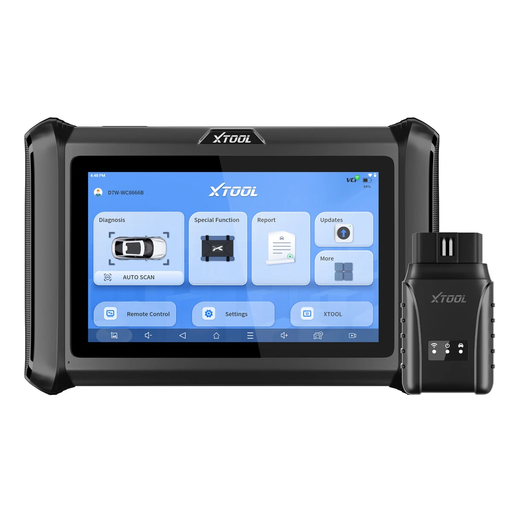
Why It Stands Out: The XTOOL D7W offers exceptional value with its 3-year free update policy, ensuring the tool remains current without ongoing subscription costs for a significant period. It stands out with its robust key programming tool capabilities and a unique Programmable Module Installation (PMI) function for Ford, Lincoln and Mazda. Its fast Wi-Fi connection provides a stable and efficient wireless diagnostic experience.
Pros:
- Long-Term Value: Includes 3 years of free software updates.
- Extensive Functions: Boasts 39+ special functions and advanced ECU coding.
- Strong Key Programming: Capable of adding keys, handling all keys lost and reading PIN codes on many models.
- Wireless Wi-Fi: Offers a faster and more stable wireless connection than many Bluetooth alternatives.
- Modern Compatibility: Supports CAN FD/DoIP and FCA AutoAuth for secure gateway access.
Who is it for? Independent garages and technicians who prioritise long-term value and require strong capabilities in key programming and module replacement alongside comprehensive diagnostics.
Autel MaxiCheck MX808S OBD2 Scanner
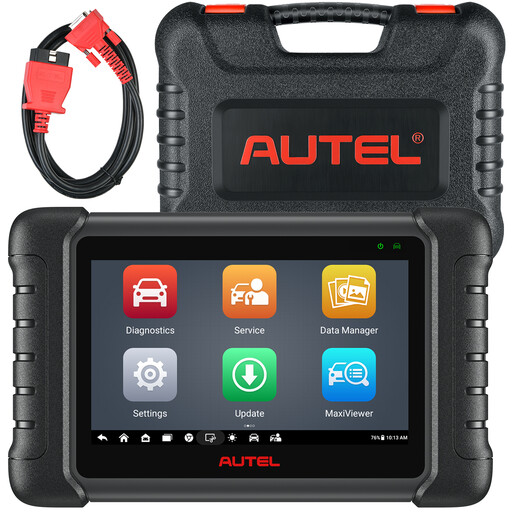
Why It Stands Out: The Autel MX808S is a workhorse known for its powerful bi-directional control and stable performance. Running on a fast Android 11 OS with upgraded hardware, it delivers a smooth user experience. While it is a wired tool, this ensures a rock-solid connection during critical diagnostic and service procedures. It provides OE-level diagnostics for all available systems, making it a reliable choice for in-depth troubleshooting.
Pros:
- Powerful Bi-Directional Control: Excellent active test capabilities for commanding vehicle components.
- Comprehensive Diagnostics: OE-Level all system diagnostic scanner for reading/clearing codes, viewing live data and retrieving ECU info.
- Extensive Service Functions: Features 38+ services, including ABS Bleed, IMMO keys and injector coding.
- Upgraded Hardware: Runs on Android 11 with a fast processor and 64GB of memory.
- FCA Vehicle Access: Supports secure gateway access for 2018+ Fiat, Chrysler and Dodge vehicles.
Who is it for? Workshops and mechanics who value a stable, wired connection and require a dependable tool with top-tier active test functions and deep system access.
Looking for Other Options?
The tools highlighted here represent some of the most capable options for professional use. However, the right tool always depends on your specific needs and budget.
If you're looking for different features or price points, explore our full range of OBD2 car diagnostic scanners to find the perfect match for your garage.
Frequently Asked Questions (FAQ)
1. What is the difference between a basic OBD2 scanner and a professional car diagnostic tool? A basic OBD2 scanner is typically limited to reading and clearing generic fault codes from the engine control unit (ECU). A professional car diagnostic tool, on the other hand, is an all system diagnostic scanner that can access every electronic module in the vehicle, including the ABS, SRS (airbag), transmission and body control modules. It also offers advanced capabilities like bi-directional control, service resets and ECU coding.
2. Do I really need a tool with ECU coding capabilities? For routine maintenance and basic diagnostics, you may not need ECU coding. However, for a professional workshop, it is becoming essential. If you plan to replace control modules, update vehicle software to fix bugs, or customise vehicle settings (like disabling start/stop), an ECU coding tool is a necessity. It separates a basic mechanic from an advanced diagnostic technician.
3. Is a wireless car scanner better than a wired one? This depends on your preference and work style. A wireless car scanner offers incredible flexibility, allowing you to move around the vehicle while viewing live data, which is ideal for testing components. A wired scanner provides a consistently stable connection that is not dependent on battery life or signal interference, which some technicians prefer for critical procedures like module programming.