
Our Top Recommendations for the Right Portable Power Station in the UK for 2026
Whether you're planning a weekend camping trip, preparing for potential power cuts or need a reliable power source for your motorhome, finding the right portable power station can feel overwhelming. With so many specifications and features to compare, it's easy to get lost in the technical details.
As a Joybuy Product Recommendation Officer, my role is to help you navigate these choices. This guide cuts through the clutter to focus on what truly matters, helping you find a dependable power solution for your outdoor adventures or as a home backup power supply.
How to Choose a Portable Power Station
Before we look at specific models, let's cover a few key considerations. Understanding these will help you identify which features are most important for your needs.
1. Understand Capacity (Wh) and Output (W)
These two numbers are the most critical specifications.
- Capacity (Watt-hours or Wh): This tells you how much energy the battery can store. A higher Wh number means it can power your devices for longer. For example, a 1000Wh station could theoretically run a 100W device for 10 hours.
- Output (Watts or W): This indicates how much power the station can deliver at any given moment. You need to ensure the output wattage is higher than the total wattage of the devices you want to run simultaneously. Check the power label on your appliances to find their wattage requirements.
2. Look for a LiFePO4 Battery
Many newer models use Lithium Iron Phosphate (LiFePO4) batteries. A LiFePO4 power station is often a sensible choice for two main reasons:
- Longevity: They can typically endure thousands of charge cycles before their capacity significantly degrades, offering a much longer lifespan than traditional lithium-ion batteries.
- Stability: LiFePO4 chemistry is more thermally stable, which contributes to safer operation, especially during heavy use or fast charging.
3. Consider Your Charging Options
How you recharge your power station is just as important as how you use it. Look for flexibility. A fast charging power station that can be replenished quickly from a wall socket is convenient for home use. For off-grid scenarios, ensure it has a solar input port. When paired with compatible solar panels, your device becomes a solar generator, providing you with sustainable power while camping or in your motorhome.
Our Top Recommendations for 2026
Here are a few portable power stations that stand out for their features and suitability for various applications.
VTOMAN FlashSpeed 1000 Portable Power Station
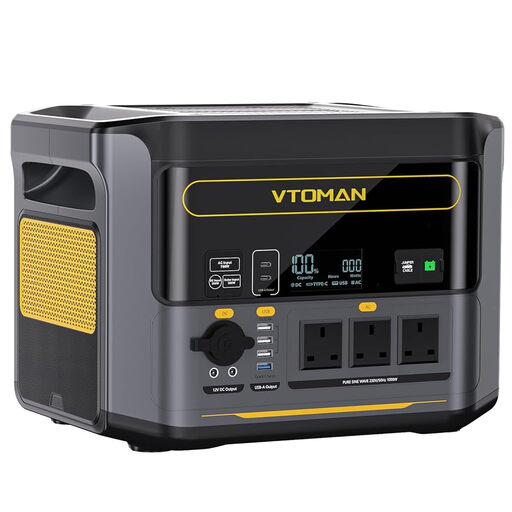
Why It Stands Out: The standout feature of the FlashSpeed 1000 is its recharging speed. With a 1000W AC input, it can charge from 0-80% in just one hour, which is exceptionally useful when you need to get back up and running quickly. It also offers the flexibility to expand its capacity by connecting an additional battery (sold separately), effectively doubling its runtime.
Pros:
- Fast AC Charging: Reaches 80% charge in approximately 60 minutes.
- Expandable Capacity: The 828Wh capacity can be increased to 2376Wh with an extra battery.
- LiFePO4 Battery: Built for longevity with over 3,000 life cycles to 80% capacity.
- Constant-Power Feature: Can supply a constant 1000W to power some appliances that exceed its rated output, preventing an immediate shutdown.
Who is it for? This is an excellent choice for homeowners needing a reliable home backup power supply and for campers who value rapid recharging between trips. The expandable capacity makes it a future-proof option for those whose power needs might grow.
VTOMAN Jump1500X Portable Power Station
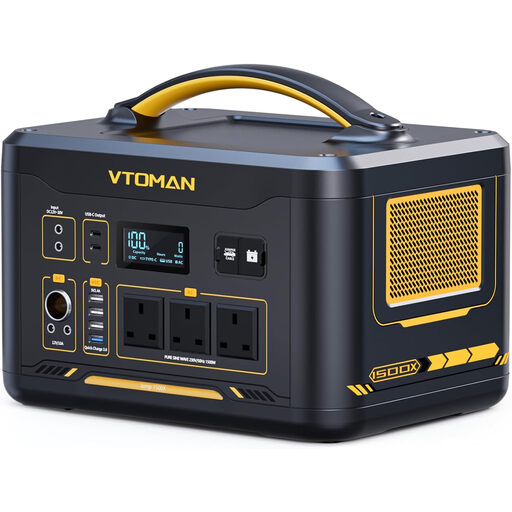
Why It Stands Out: The Jump1500X combines the functions of a high-output power station with a vehicle jump starter. Its 1500W AC output (with a 3000W surge) can handle more demanding appliances, while the regulated 12V DC ports are ideal for powering devices like portable fridges without voltage drops.
Pros:
- High Power Output: A 1500W continuous output supports a wider range of appliances.
- Built-in Jump Starter: Adds a layer of security for vehicle-based travel, making it a great motorhome power station.
- Powerful USB-C Ports: Includes two 100W PD Type-C ports for fast-charging laptops and other modern electronics.
- Regulated 12V DC Output: Provides stable power for sensitive 12V devices like CPAP machines and car refrigerators.
Who is it for? This unit is particularly well-suited for motorhome travellers, van-lifers and anyone who wants an all-in-one power solution for both their campsite and their vehicle. The high output and robust port selection also make it a capable backup for home essentials.
Jackery Explorer 1000 v2 Portable Power Station
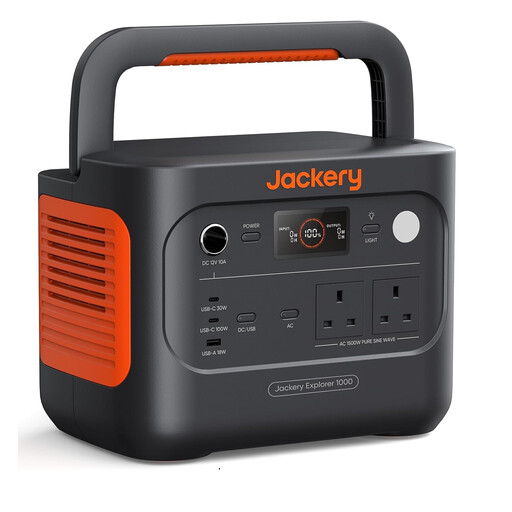
Why It Stands Out: The Jackery Explorer 1000 v2 builds on a well-regarded platform with modern upgrades. It features a durable LiFePO4 battery rated for 4,000 cycles and smart app control via Wi-Fi or Bluetooth. This allows you to monitor status and select different charging modes, including a quiet mode for overnight charging.
Pros:
- Smart App Control: Monitor and manage charging modes remotely for convenience and battery health optimisation.
- Very Long Battery Lifespan: The LiFePO4 battery is rated for 4,000 cycles to 70%+ capacity.
- Multiple Charging Modes: Choose between ultra-fast, standard or quiet charging to suit your situation.
- High Power Output: Delivers 1500W of continuous AC power with a 3000W surge peak.
Who is it for? This is a strong contender for tech-savvy users who appreciate smart features and brand reputation. It's a versatile unit for power station for camping trips, off-grid work and emergency preparedness, especially for those who value quiet operation.
Looking for Other Options?
If these models don't quite match your specific requirements for capacity, size or features, there are many other choices available. To see a wider selection of models suitable for various needs and budgets, you can explore our broader collection of camping portable battery options.
Frequently Asked Questions
What can a 1000Wh portable power station run?
A station with around 1000Wh of capacity can typically power a range of small to medium devices. This includes charging laptops (15-20 times), smartphones (80+ times) and running a mini-fridge (15+ hours), a TV (10+ hours) or CPAP machine (15-20 hours). Always check the wattage of your specific appliance to calculate its approximate runtime.
Is a LiFePO4 power station worth it?
For most users, yes. While they can sometimes have a higher initial cost, their significantly longer lifespan (often 3-4 times more charge cycles than other types) means they offer better long-term value. Their enhanced thermal stability also provides an additional layer of safety, which is a crucial consideration for a device you might use in your home, tent or vehicle.
How long does it take to charge a portable power station with solar panels?
Charging time with a solar generator setup varies greatly depending on the wattage of the solar panels, the power station's maximum solar input and weather conditions. For a 1000Wh station, using a 200W solar panel in ideal, direct sunlight might take 6-8 hours. With a 400W solar array, this could be reduced to 3-4 hours. Overcast skies will increase charging times considerably.